
TSS-A704 · Gen3 SuperSensor
Six Sensors. One Sealed Block.
A Quarter-Century of Memory.
The Gen3 SuperSensor Tag is a ruggedized, epoxy-encapsulated wireless monitor for military and industrial assets: temperature, humidity, pressure, 3-axis shock, 3-axis vibration, and optional motion/tamper sensing, with a RuBee (IEEE 1902.1) magnetic link that reads through sealed steel — HERF ZERO, HERO ZERO, and physically secure.
10 yr
2/3AA · on request
15 yr
AA · 2.90″×1.15″×0.81″
25 yr
2×AA · 2.90″×1.70″×0.81″
Interactive · Pick Your Service Life
Three Builds. One Platform.
| Battery | |
| Size | |
| Service life | |
| Best fit |
DIAGRAM DRAWN TO SCALE · AA CELL 1.99″ × 0.57″ · 2/3AA 1.12″ × 0.57″
Engineering, Not Magic
Why a Tag Runs 25 Years on One Cell
It is not because 131 kHz is cheap to transmit. When the tag talks, it drives its tank circuit with far more current than the battery could sustain for even a year — a tag made to transmit continuously dies in months. The tag lasts because it is almost never awake, and because everything about it is built so that “asleep” really means a few microamps.
The hard part is not the design — it is finding and removing the rogue few-microamp draw that is almost always there at first. Every tag is measured for sleep current before it is potted.
01 · LISTEN
< 2 µA to watch for a reader
The RuBee chip monitors for carrier at under two microamps. It only drives the antenna when a reader is actually talking to it.
02 · SLEEP
Instant-on, otherwise off
Sensing and logging run on dedicated low-energy hardware — our own silicon in the smaller tags, commercial ultra-low-power MCUs in the SuperSensor. Essentially the whole chip is off between tasks, then wakes at full clock in microseconds.
03 · CELL
Industrial cells that do not age
Highest-grade lithium primary cells, specified above all for a case that will not degrade the way an ordinary battery does over two decades.
04 · POT
Immersed in epoxy
The assembly is fully potted, so temperature, humidity and high-g shock cannot reach the electronics or create leakage paths over time.
05 · MEASURE
100% of tags measured before potting
R&D spends its time hunting microamps. A single stray draw of a few µA is almost guaranteed to be present initially and is nearly invisible — so every production tag has its sleep current verified before it is sealed. That is the difference between a 25-year tag and a 5-year one.
Inside the Tag
Open the Block.
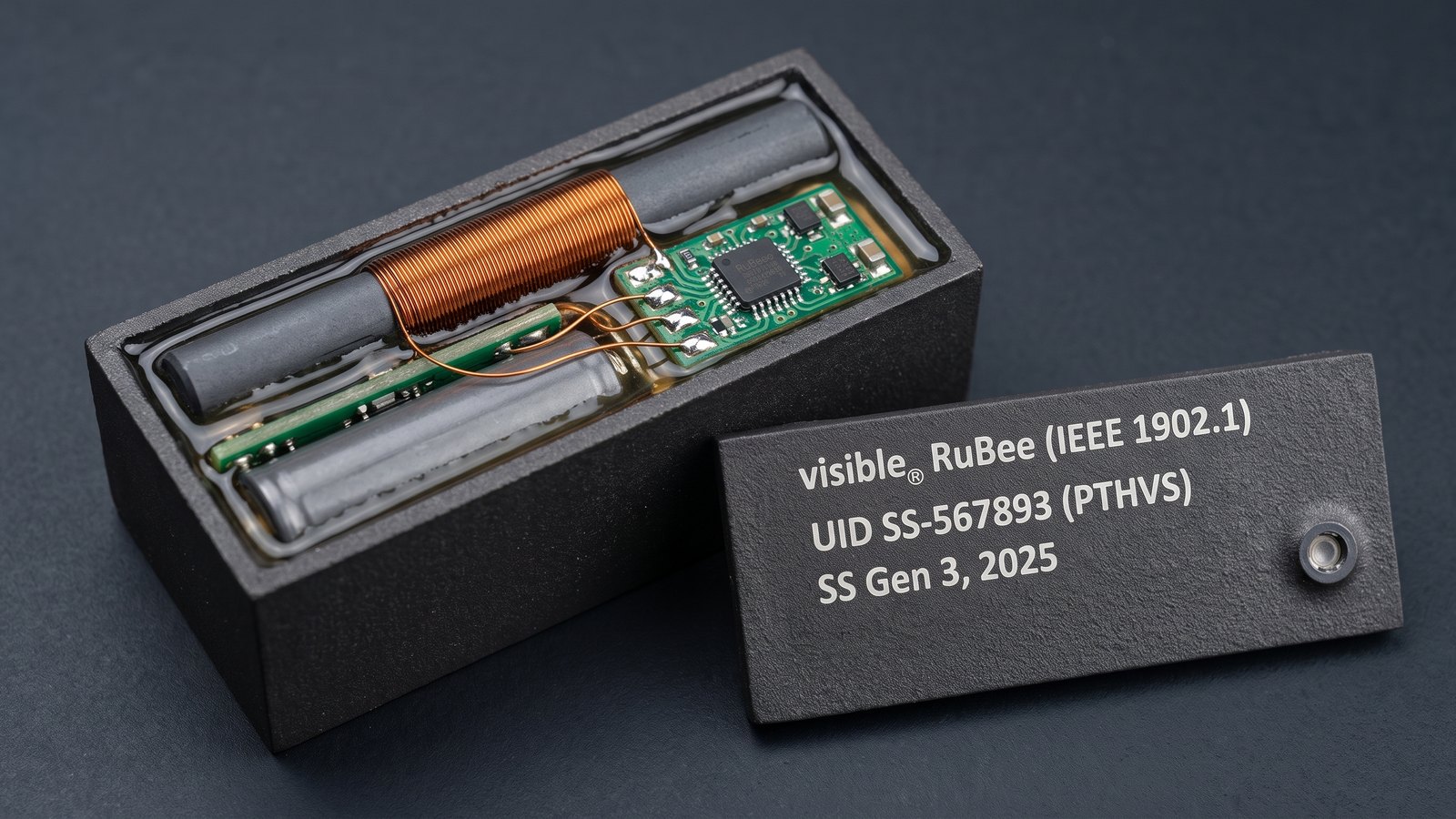
The sealed epoxy block turns to glass, the lid lifts, and the camera settles inside — then every part gets its name.
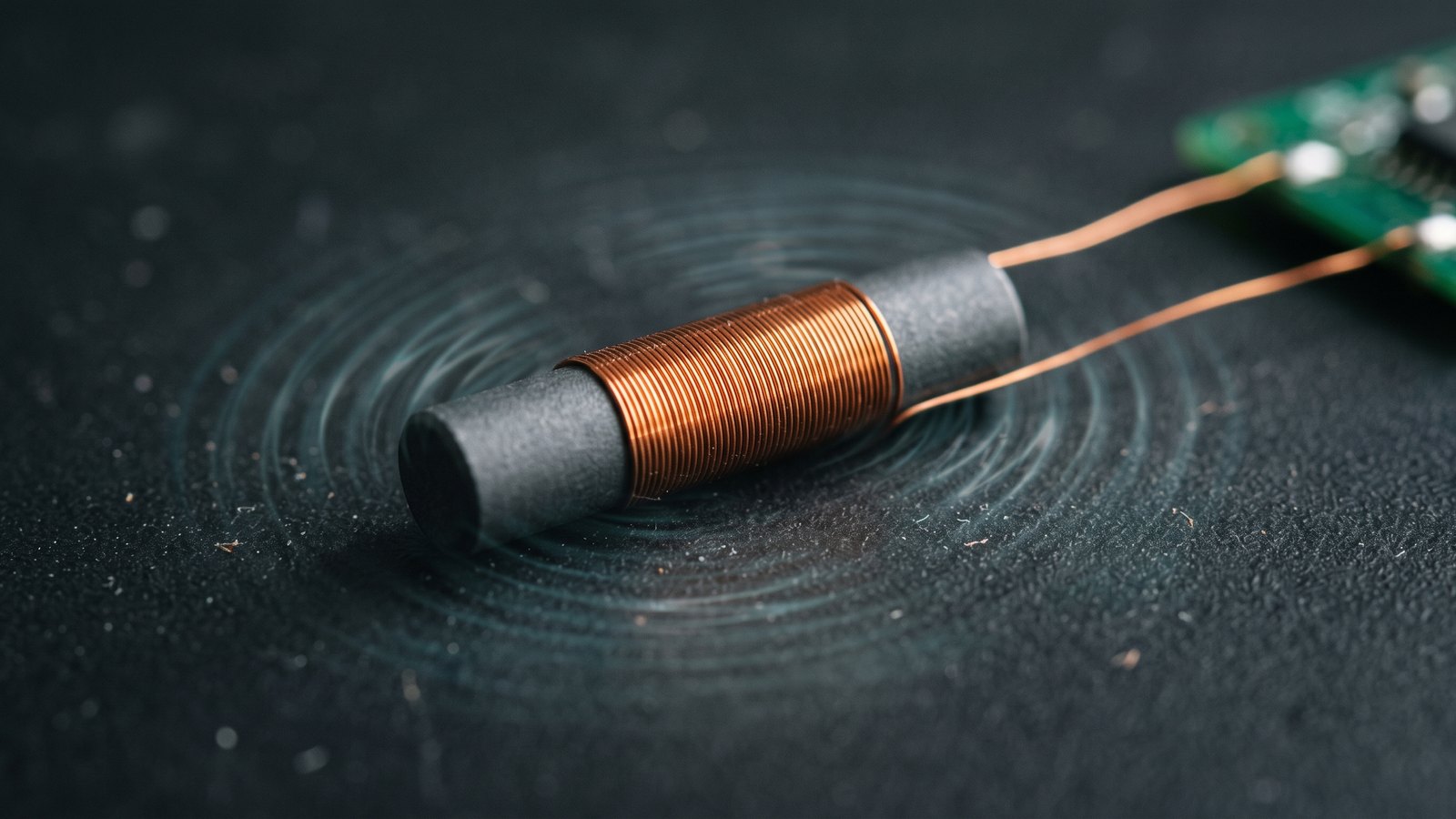
Ferrite rod antenna
A dark ceramic ferrite core, not a radio antenna. Steel beside it does not de-tune it — steel helps.
Thin magnet wire
Hundreds of turns of hair-fine enamelled copper make the rod a tuned 131 kHz magnetic tank circuit.
Magnetic, not radio
Near-field only: reads through steel, water and closed cases, and sinks into noise just beyond read range — HERO & HERF ZERO.
RuBee IC + low-energy MCU
Listens for a reader at < 2 µA. Everything else is powered down until a task, then instant-on.
Six sensors
Temperature, humidity, pressure, 3-axis shock to ±200 g, vibration PSD, motion — logged on the tag.
Epoxy fill
Fully potted: temperature, humidity and high-g shock never reach the electronics. MIL-STD 810H · IP68.
AA LITHIUM CELL (OUT OF FRAME) · 15 / 25-YEAR BUILDS · SLEEP CURRENT MEASURED ON 100% OF TAGS BEFORE POTTING
Technical Specifications
The Sensor Suite
Six channels on one board, next to the RuBee IC and the ferrite rod antenna, with the lithium cell beside them — and the whole assembly potted in epoxy before the lid goes on. Every channel keeps its own histogram, excursion traces and timestamped log on the tag itself.
TSS-A704 · 2.90″ × 1.15″ × 0.81″ · MIL-STD 810H · IP68
Temperature
CH 01-40°C to +85°C · 0.5°C resolution
Full-life high-resolution histogram plus 8 worst-case excursion traces, high and low, with date and time. Over 40°C is destructive to energetics — and logged.
Humidity
CH 020–100% · 3% res (0–80%), 5% (80–100%)
Histograms and excursion logs identical to temperature. Catches seal failures before corrosion and hygroscopic degradation set in.
Pressure / Altimeter
CH 03300–1200 mBar · 0.5 mBar resolution
Certifies the date and time of every aircraft takeoff and landing; verifies pressurized cases are still holding.
Shock
CH 043-axis ±200g · 0.1g resolution · 6400 Hz
Wakes on impact; keeps the 15 worst traces at 112 samples each, X/Y/Z plus magnitude. Over 40g is serious. Over 80g is damaging. Every magnitude lands in the histogram.
Vibration
CH 053-axis ±16g · PSD 0–750 Hz @ 1.5 Hz bins
Cumulative Power Spectral Density reveals both magnitude and frequency of lifetime exposure — the fingerprint of vibration damage to rocket motors and electronics.
Motion (optional)
CH 06IR short-range · date/time · duration
Detects movement or tampering near the asset — intrusions logged with timestamp, duration, and magnitude.
Interactive · The Six Channels
Temperature
-40°C to +85°C · 0.5°C resolution
Full-life histogram plus 8 worst-case excursion traces, high and low, with date and time. Over 40°C is destructive to energetics — and logged.
Data Architecture
| Event log | 9,212 events — temperature, humidity, pressure |
| Excursion traces | 8 worst-case per channel (T / H / P), high and low |
| Shock traces | 15 worst events · 112 samples @ 6400 Hz, X/Y/Z |
| Vibration | Cumulative PSD, 0–750 Hz at 1.5 Hz intervals |
| Histograms | High and low resolution, full tag life |
| Histolog | Synthesized ~20-year log for Arrhenius life estimation |
| Format | JSON export of all data · CSV · reload from file |
Environment & Certifications
| Package | Epoxy encapsulated · MIL-STD-810H · IP68 |
| Intrinsic safety | HERO ZERO · HERF ZERO · ATEX Zone 0 · UL Class I Div 1 |
| Nuclear | USAF Dash-12 approved · only wireless approved by US DOE on/near warheads |
| Security | No significant compromising emanations — no Tempest, target, or eavesdropping risk |
| Human safety | FDA Class 1 Non-Significant Risk · Mayo Clinic reviewed |
| Wireless | RuBee IEEE 1902.1 · 131 kHz magnetic · ~20 ft standard range |
| USB | Optional — firmware upgrades and full-speed data download |
Proven With
Current RuBee installations · certifications →






Why Magnetic Wins
The Case Stays Sealed. Forever.
RFID, Bluetooth, LoRa, NFC — every RF protocol is blocked by the steel it must penetrate and is an emissions risk where weapons live. RuBee’s 131 kHz magnetic field passes through steel, aluminum, titanium, and liquids with no multipath, 100% read rates, and ±6-inch geolocation. The tag is commissioned at manufacture, sealed inside with the asset, and answers every audit for the next 25 years — through the case.
RuBee: 131 kHz magnetic field passes through the steel wall — READ, 100%.
Same tag position, same sealed steel case, same reader — only the physics changes.
Price Competitive
Benchmarked Against the Market Primes Actually Use
Public distributor pricing puts industrial piezo accelerometers at $250–$900 each, high-shock ordnance accelerometers in the low thousands, and tactical IMU motion cores at $200–$2,000 — before packaging, sealing, qualification, and calibration, which usually dominate. The Gen3 Health Tag delivers six qualified sensors, the datalog, and the secure wireless link in one sealed MIL-STD package, priced against ordinary commercial sensor tags — and it never needs a recharge, a wire, or a case opening.
| Approach | Sensors | Battery | Reads through steel | Emissions-safe on ordnance |
|---|---|---|---|---|
| Commodity MEMS node | 1–3, unqualified | Rechargeable, days–months | No | No |
| Industrial piezo / IEPE | 1, wired | External power | Wired only | No |
| Tactical IMU module | Motion only | External power | No | No |
| Gen3 Health Tag (TSS-A704) | 6, MIL-qualified | 10 / 15 / 25-year primary | Yes — IEEE 1902.1 | HERO / HERF ZERO |
Reading the Tag
From Handheld Check to Site-Wide Audit
MiniCom
PORTABLE · USB · 10 FT RANGE
A compact reader with microcontroller, base station, and antennas — tablet or laptop as controller. 0.5 lb, −40°C to +85°C, IP65, FCC Part 15B, HERO SSD = 0.
Sidewinder & Viper
FIXED BASE STATIONS · NETWORKED
Rack, door, and bay antennas for scheduled automatic audits of whole magazines — the same architecture proven in Armory 20/20® at DOE and USAF sites.
Direct USB
OPTIONAL · FULL-SPEED DOWNLOAD
For commissioning, firmware upgrades, and complete high-speed datalog extraction — Windows, Linux, and Mac.