
Prognostic Health Management · CBM+
Why Weapons Fail — and Why the Tests They Pass Can’t See It Coming
Missile failures are rarely one broken part. They are component-level damage and aging that surface under extreme environments: shock, vibration, thermal gradients, EMI, and time. PHM — Prognostic Health Management — is the discipline of watching those stresses continuously, so maintenance is driven by condition, not calendar. The DoD calls it CBM+. It has been mostly unexecutable for one reason: no sensor could survive the asset’s life, inside a sealed case, without wires. That sensor now exists.
What Actually Fails
Destructive stockpile testing identifies three major failure classes — mechanical/structural, electrical, and energetic (warheads, propellants, thermal batteries, gas generators, solid rocket motors). The triggers are the environmental history nobody records:
- ▸ Accelerated chemical aging of energetics from temperature excursions — tarmac reaches 140°F; nine hours on a runway is a logged event.
- ▸ Corrosion, delamination, or cracks in solid rocket motors.
- ▸ Seal failures that let humidity reach energetics and electronics.
- ▸ Electrical and energetic components broken by shock or vibration in handling and transport.
- ▸ Gyroscope bearing degradation; seeker performance loss tied to high-temperature storage.
Failure → Root Component
| Failure Type | Typical Root Component |
|---|---|
| Launch failure | Igniter, battery, SRM, motor |
| Missed target | IMU, seeker, GPS, INS |
| Loss of control | Actuators, FCC, motor |
| No detonation | Fuze, S&A device |
| Mid-flight shutdown | Power system |
| Erratic behavior | Structural wiring, MEMS, motor |
UNCLASSIFIED, ORDER-OF-MAGNITUDE ENGINEERING SUMMARY
The Stockpile Math
Destructive Sampling Throws Away Good Missiles
In-service surveillance has historically meant destructively testing randomly selected missiles and extending the result to the whole stockpile. Stack conservative safety factors on top, and assets are disposed of expensively and prematurely. Per-asset condition history inverts that: retire the units with the abuse record, keep the ones with a clean twenty-year log — and when the mission matters, pick the asset most likely to succeed.
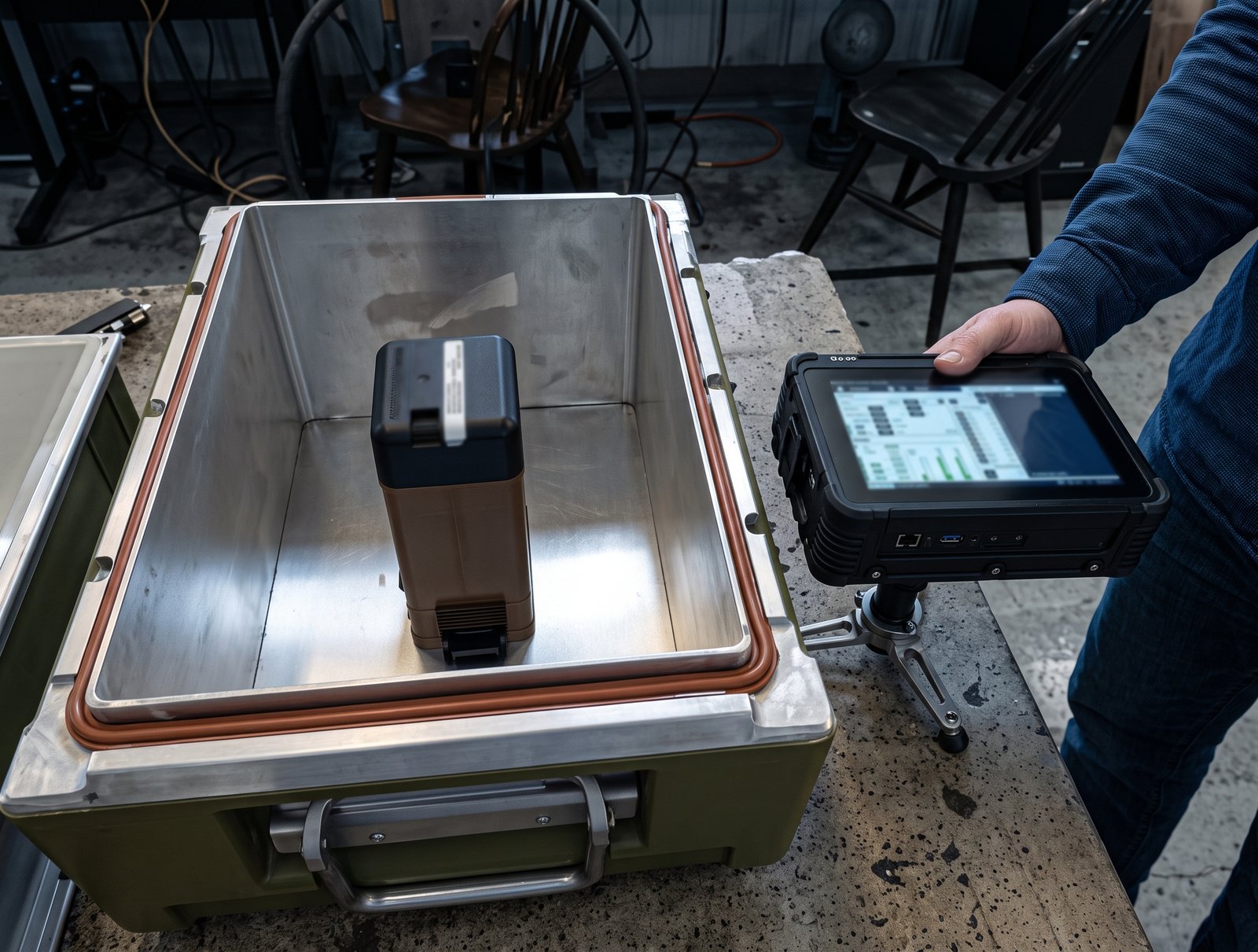
A real read: the tag answers from inside the sealed case — per-asset history without opening a single lid.
Transport
1–2 month datalogs certify every leg: takeoffs and landings by altimeter, shocks by 3-axis accelerometer, temperature on the tarmac. Chain-of-custody ambiguity ends.
Storage
2 months to 20 years in bunkers and magazines — histograms plus worst-case excursion logs for every sensor, read in place without opening the case.
Forward Location
Mobile or fixed readers pull Red Flags in half a second; data moves to command and control over a satellite link. Kill-chain logistics, optimized.
Interactive · Drag the Asset Through Its Life
What Each Layer Sees, Moment by Moment
Drag the slider. BIT and ATE only exist at their events. The Health Tag never stops.
BIT SEES
Power-up self-test at the factory: PASS.
ATE SEES
Full certification on the bench: PASS. The last complete look it will get for years.
HEALTH TAG RECORDS
- ✓ Commissioned. Thresholds set. Logging.
The Layered Assurance Stack
BIT vs ATE vs Health Tag, Dimension by Dimension
| Dimension | BIT (Built-In Test) | ATE (Test Equipment) | Health Tag (Non-Invasive) |
|---|---|---|---|
| Location | Inside the weapon | External test station | Strap-on or embedded — no electrical contact |
| When it runs | Power-up, pre-launch | Maintenance / turnaround | Continuous: storage, transport, handling |
| Detects best | Hard failures, unsafe states | Functional & parametric faults | Latent damage, abuse, environmental stress |
| Fault isolation | Shallow–medium | Deep (LRU/SRU level) | Contextual — tells ATE where to look |
| Safety role | First line of defense | Certification gate | Evidence & forensics |
| False-removal reduction | Limited | Moderate | High — context eliminates “No Fault Found” |
| Data persistence | Usually volatile | Test records only | 20-year historical log on the asset |
| Cyber / safety exposure | Internal system risk | Controlled environment | Isolated, non-interfering |
BIT and ATE say “pass / fail.” The Health Tag says “why at risk.”
Case Study
The Mk 48 Torpedo: A World-Class Test Stack, With One Blind Spot
The Mk 48 program layers embedded BIT, the Mk 660 Mod 2 ATE, and a dozen purpose-built subsystem testers — cable sets, steering testers, exploder test sets, fuel and hydraulic rigs. It is one of the most thoroughly tested weapons in service. Every one of those tests is event-based. Between events, the weapon is handled, trucked, craned, and stored — unobserved.
HEALTH TAG: HIGH VALUE
Harness intermittents
Micro-interrupts, shock-correlated discontinuities, humidity and ESD exposure that bench tests never see.
HEALTH TAG: HIGH VALUE
Fuel & hydraulic degradation
Pressure, temperature, and vibration trends catch slow leak-down in storage — the classic latent fault.
HEALTH TAG: HIGH VALUE
Transport & handling abuse
Shock spectrum, orientation, and exposure history keep “unknown abuse” out of inventory.
HEALTH TAG: HIGH VALUE
Sensor drift & aging
Embedded BIT catches gross faults; the tag trends the slow drift between tests — and the squib aging BIT can’t.
Executive takeaway: BIT keeps the weapon safe, ATE proves it works, and the Health Tag proves it wasn’t damaged in between.
The Largest Diagnostic Blind Spot
Transport Damage. Handling Shock. Environmental Exposure. Chain-of-Custody Ambiguity.
One tag closes all four — from device birth to the final event.